Precision Maintenance | Shaft Alignment | Machinery Reliability
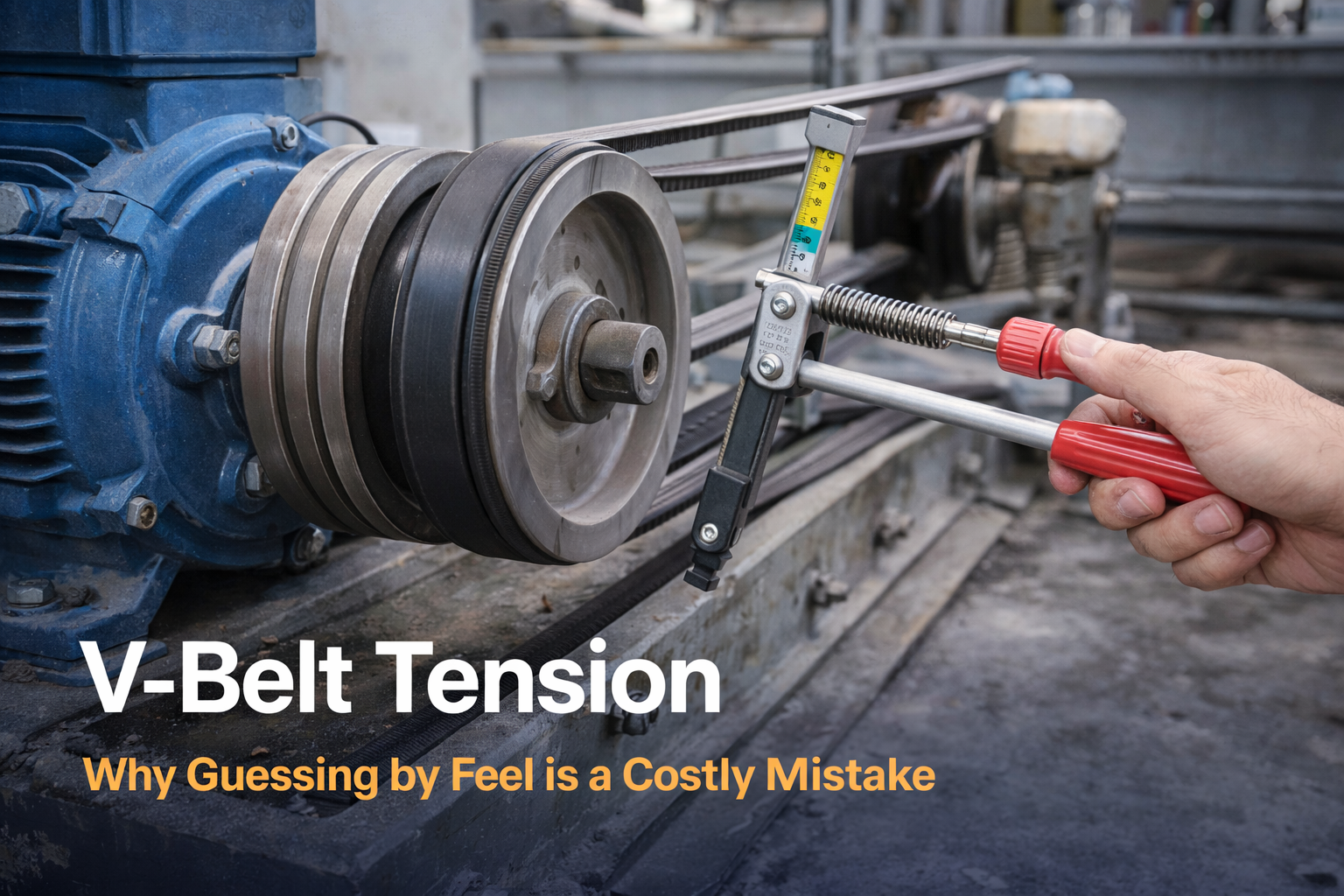
One of the most underestimated tools in precision maintenance is the V-belt tension gauge. Many technicians rely on experience or “feel” when tensioning belts, believing that hand judgment is sufficient. While experience is valuable, relying on feel alone often leads to over-tensioned belts, which can silently shorten equipment life.
In precision maintenance practices, belt tension should always be measured—not guessed.
The Problem with “Tension by Feel”
In maintenance training and field observations, belt tension set by feel is frequently found to be too high when verified using a tension gauge. Over-tensioning may initially appear acceptable, but it introduces excessive forces into the system.
Incorrect belt tension is one of the hidden contributors to:
Premature bearing failures
Excessive heat generation
Increased energy consumption
Shortened belt and sheave life
Precision maintenance starts with objective measurement, not subjective judgment.
Benefits of Proper V-Belt Tension
Correct belt tension—combined with proper shaft alignment and adequate ventilation—can significantly improve equipment performance and reliability.
Key Advantages:
Extended belt and sheave life
Reduced bearing load and longer bearing life
Lower friction and operating temperature
Reduced unplanned downtime
Improved energy efficiency
Less material waste from premature belt replacement
When belts are tensioned correctly, power transmission is optimized without overloading mechanical components.
Risks of Incorrect Belt Tension
Under-Tensioned Belts:
Slip excessively
Cause rapid belt and sheave wear
Generate heat and vibration
Over-Tensioned Belts:
Apply excessive radial load to bearings
Accelerate bearing fatigue
Can distort shafts and sheaves
It is important to remember that industrial V-belts can have break strengths of several thousand pounds. Excessive tension transfers this force directly into the bearings—often without immediate visible symptoms.
Types of V-Belt Tensioning Tools
There are several reliable methods for setting belt tension accurately:
Spring-loaded belt tension gauges
Sonic (frequency-based) belt tension tools
Both methods are effective when used correctly and with proper manufacturer data.
Key Data Required for Accurate Belt Tensioning
To set belt tension correctly, technicians must know:
Belt size and type
Horsepower transmitted
Sheave diameters
Distance between shaft centers
Required belt deflection
Specified deflection force
Most belt manufacturers provide this information in their technical documentation.
Engineering-Based Belt Tensioning at ORBITLINE
At ORBITLINE, belt tensioning is treated as a precision maintenance activity, not a trial-and-error task. We apply:
Manufacturer-recommended calculations
Engineering tools and software
Verified measurement using calibrated tension gauges
This ensures belts operate within design limits while protecting bearings, shafts, and couplings.