Advanced Vibration Analysis | Machinery Reliability | Structural Dynamics
Resonance, critical speed, and natural frequency are closely related terms that describe the same physical phenomenon—the tendency of a structure or machine component to vibrate excessively when excited at a specific frequency. Every mechanical system, regardless of size or complexity, has one or more natural frequencies.
When operating speed coincides with any of these natural frequencies, vibration levels can increase dramatically, even when no traditional mechanical fault is present.
For reliability engineers, understanding resonance is critical because it often explains high vibration without an obvious root cause.
How Resonance Affects Rotating Equipment
The impact of resonance can be severe and destructive. When a machine operates at or near its critical speed, even small excitation forces can produce large vibration amplitudes.
This condition causes continuous bending of shafts and structures—similar to repeatedly bending a metal wire until it fractures. Over time, resonance can lead to:
Shaft fatigue and cracking
Structural failure of bases and frames
Premature bearing and seal damage
Excessive vibration and noise
Resonance-related failures typically progress quickly once the critical speed is reached.
How to Identify Resonance in the Field
1. Run-Up and Coast-Down Testing
Run-up and coast-down tests are among the most effective methods for identifying resonance. During these tests, vibration data is collected while the machine speed is gradually increased or decreased.
Using a tachometer, the data is displayed in:
Waterfall plots
Bode plots
Resonance is identified by a sharp increase in vibration amplitude at a specific speed, independent of typical fault frequencies.
2. Impact (Bump) Testing
Impact testing involves exciting the structure using an instrumented hammer or mallet to “ring” its natural frequencies.
The response is captured using vibration sensors and displayed in the frequency spectrum. This method allows engineers to identify:
Natural frequencies
Structural stiffness issues
Resonant modes
Both impact testing and run-up/coast-down testing should yield consistent results when performed correctly.
Understanding Natural Frequency and Mode Shapes
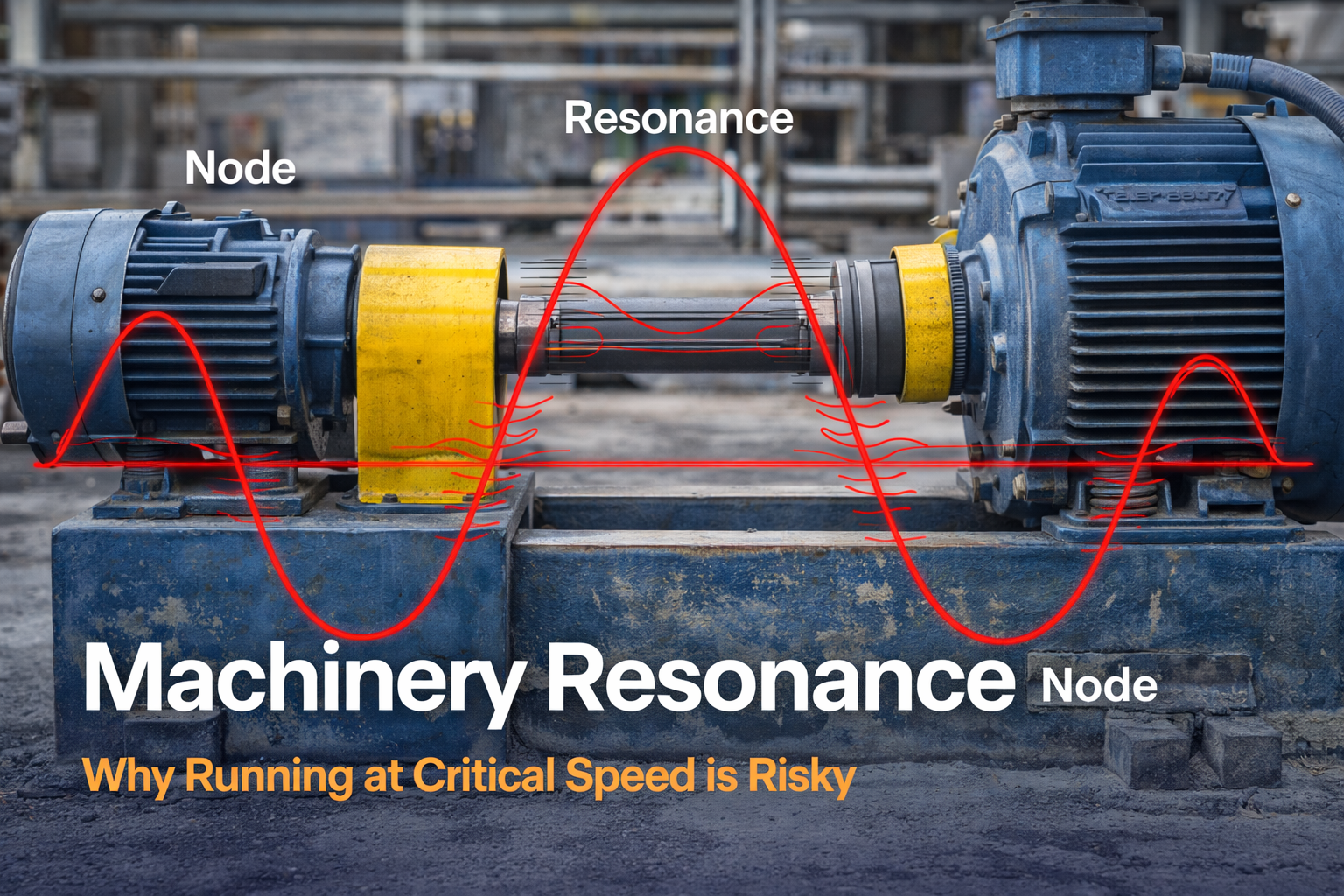
Natural frequency causes physical deflection of components in predictable patterns known as mode shapes.
First Mode:
A single bending shape where vibration amplitude is lowest at the bearings (nodes) and highest at the shaft center (antinode).Higher Modes:
Multiple bending shapes appear between support points, creating several nodes and antinodes.
In theory, a structure has infinite modes, but typically only the lower modes are of concern in rotating machinery.
Nodes and Antinodes: Why Location Matters
Node: Area of minimal vibration amplitude
Antinode: Area of maximum vibration amplitude
Modifications made at nodes have little influence on natural frequency. However, changes made at antinodes can significantly shift the system’s dynamic behavior.
Identifying these locations is essential when planning corrective actions.
How to Change or Control Natural Frequency
Natural frequency can be modified by changing:
Stiffness
Mass
Increasing Stiffness
Raises natural frequency
Achieved by adding supports, braces, or reinforcing structures
Increasing Mass
Lowers natural frequency
Achieved by adding mass blocks, plates, or tuned dampers
The goal is to shift the natural frequency away from the machine’s operating speed and its harmonics.
Alternative Mitigation Methods
In some cases, it is more practical to adjust operating conditions rather than modify the structure:
Changing machine speed
Adjusting VFD settings to avoid critical speeds
Modifying pulley or sheave sizes in belt-driven systems
These approaches are often faster and cost-effective when structural changes are not feasible.
ORBITLINE’s Approach to Resonance Problems
At ORBITLINE, resonance issues are addressed using an integrated engineering approach:
Advanced vibration analysis
Run-up / coast-down testing
Impact testing and modal analysis
Motion Amplification (RDI)
Structural and foundation evaluation
Our objective is not just to detect resonance—but to engineer permanent solutions that improve machine reliability and service life.