Condition Monitoring | Vibration Analysis | Reliability Engineering
Frequency is one of the most fundamental concepts in vibration analysis. In simple terms, frequency describes how often a repeating event occurs within a specific time period. In machinery diagnostics, frequency helps us connect vibration data to physical machine components and identify developing faults before failure occurs.
In vibration analysis, frequency is typically expressed as:
Hertz (Hz) – cycles per second
Cycles Per Minute (CPM) – commonly used in rotating machinery
Understanding Frequency in Rotating Equipment
Every rotating machine produces vibration at specific frequencies related to its mechanical components. When we measure vibration, we are essentially measuring repeating motion patterns that occur due to rotation, loading, or mechanical interaction.
For example:
Shaft rotation
Gear tooth contact
Pump vane pass
Bearing defect frequencies
Each of these events creates vibration at a predictable frequency.
Calculating Frequency and CPM
Frequency is calculated using the formula:
Frequency (Hz) = 1 / T
Where T is the time (in seconds) for one complete cycle.
Example:
If an event repeats every 0.03 seconds:
1 ÷ 0.03 = 33.33 Hz
To convert Hz to CPM:
33.33 × 60 = 2000 CPM
This means the event occurs 2000 times per minute.
Why Frequency Peaks Matter in Vibration Analysis
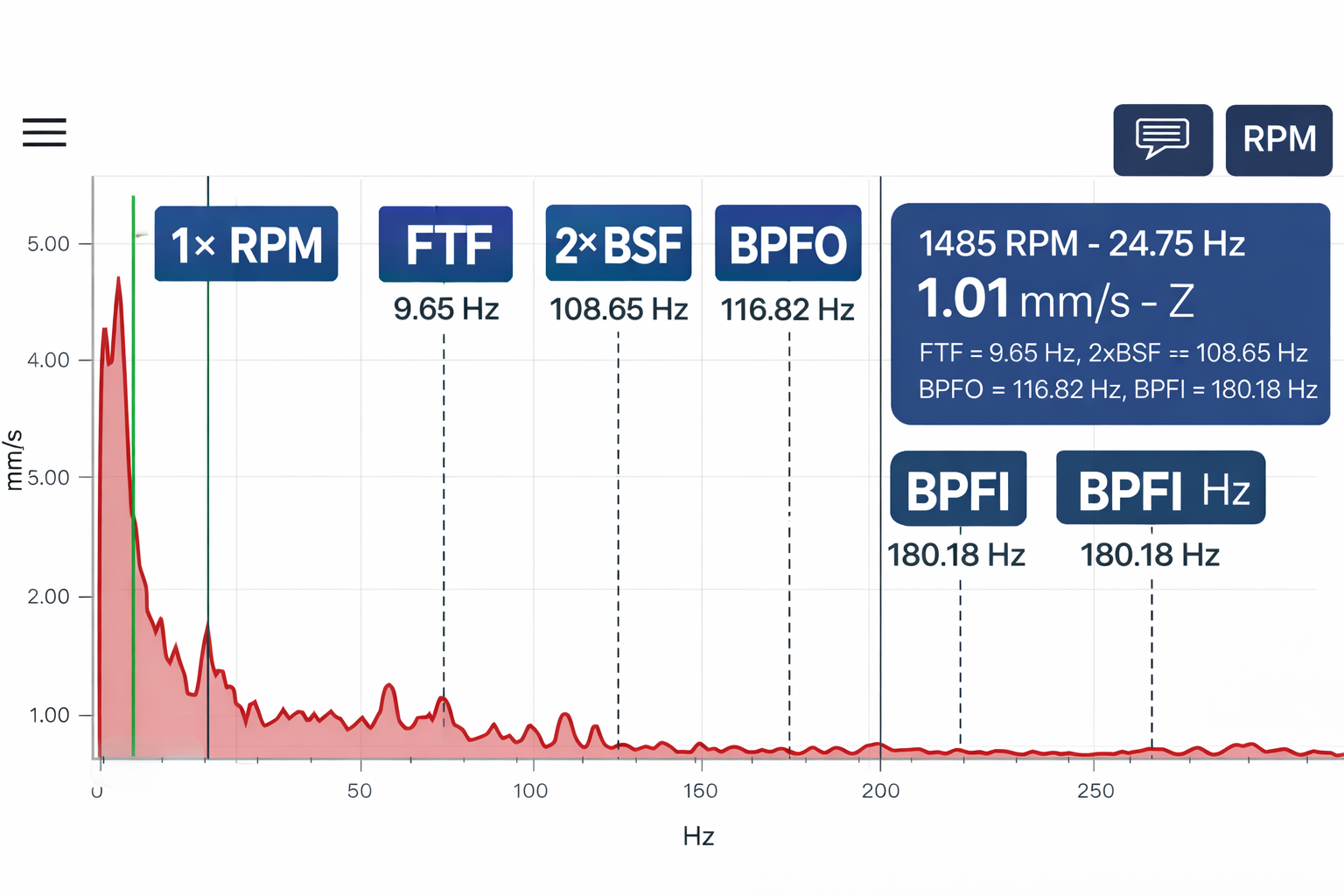
When analyzing vibration data, engineers focus on distinct frequency peaks in the FFT spectrum. Each peak represents a repeating mechanical event occurring inside the machine.
By comparing measured frequencies with known machine data (RPM, number of blades, gear teeth, bearing geometry), we can accurately identify fault sources.
Common Examples:
Unbalance: 1× running speed
Gear Mesh Frequency: Number of teeth × shaft RPM
Pump Vane Pass Frequency: Number of vanes × RPM
Electrical Issues: Line frequency or multiples
Understanding these relationships allows early detection of mechanical issues such as unbalance, misalignment, looseness, gear wear, or hydraulic instability.
Frequency in Pumps and Gearboxes
Gearboxes:
If a gear has 20 teeth, there will be 20 contact events per shaft revolution, producing vibration at 20 × RPM.Centrifugal Pumps:
A pump with 5 vanes will generate vibration at 5 × RPM as each vane passes the volute.
These frequencies are clearly visible in the vibration spectrum and provide strong diagnostic clues.
Frequency vs. Period – Knowing Both Matters
Frequency and period are inversely related.
Period (seconds) = 1 / Frequency (Hz)
Using the same example:
Frequency = 33.33 Hz
Period = 1 ÷ 33.33 = 0.03 seconds
Understanding period is especially useful when analyzing:
Time waveform data
Slow-speed equipment
Impact and looseness events
In low-speed machinery, FFT analysis may be less effective, and time waveform analysis becomes critical.
Why Frequency Knowledge Is Critical for Reliability
When vibration frequencies are properly understood and interpreted:
Mechanical faults are identified early
Corrective actions can be planned proactively
Unexpected breakdowns are avoided
Machine life and reliability are improved
This is the foundation of Condition-Based Maintenance (CBM) and modern reliability programs.
How ORBITLINE Supports Frequency-Based Diagnostics
At ORBITLINE, we use advanced vibration analysis techniques, including:
FFT spectrum analysis
Time waveform analysis
Order tracking
Modal and structural vibration analysis
Motion Amplification (RDI)
These methods allow us to accurately link vibration frequencies to machine behavior and deliver actionable engineering recommendations—not just data.