Which Machines Are Critical to Your Plant?
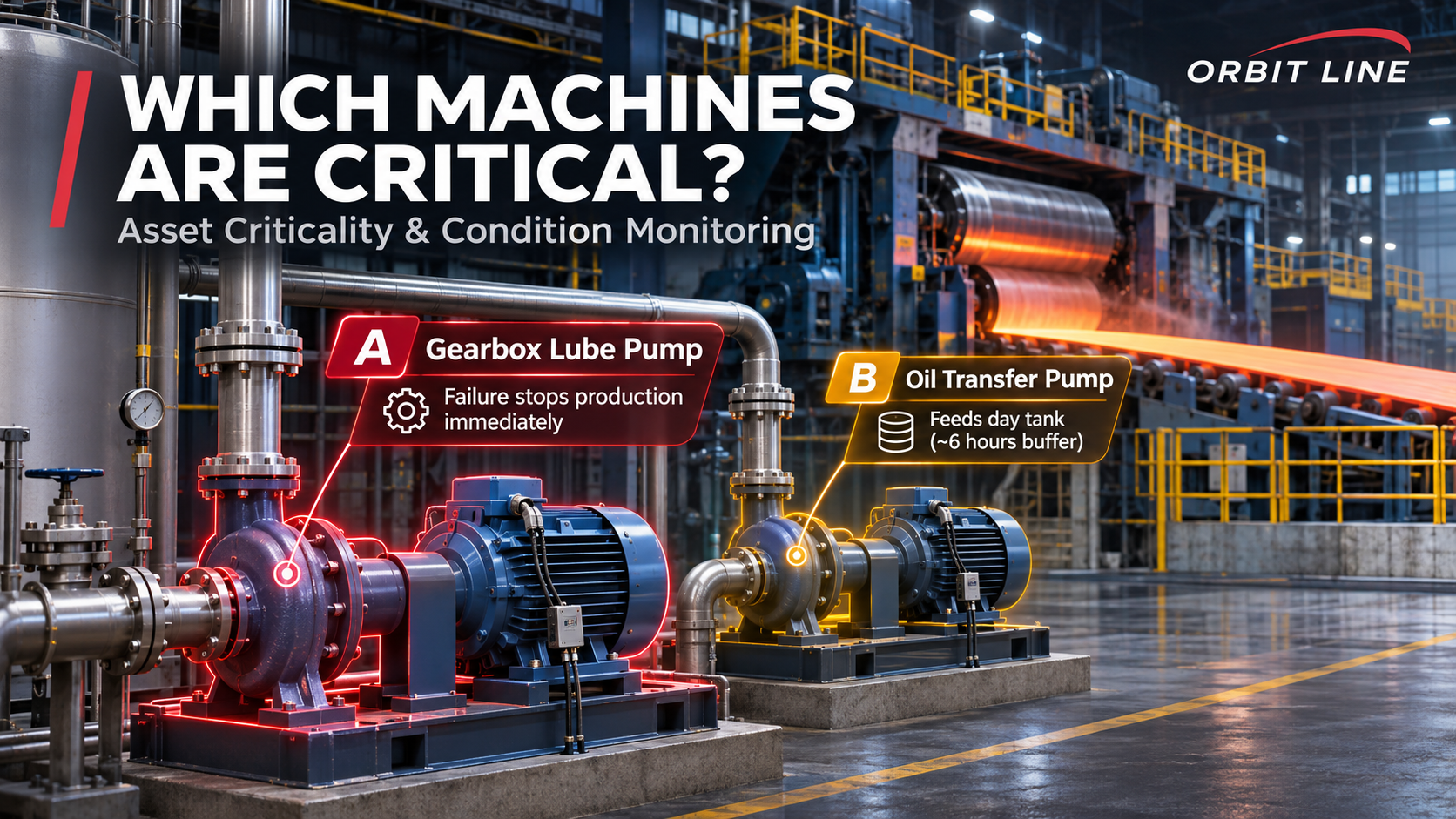
Two identical pumps sit beside a rolling line. One supplies lubricating oil to the mill gearbox. The other transfers fresh oil from storage to a day tank. Which one deserves closer monitoring?
Ask the shift supervisor what happens if each pump trips at 2 a.m. If the gearbox loses oil pressure, the mill may trip within seconds. If the transfer pump stops, the oil already in the day tank may carry production through the shift. The pumps may even share a spare motor. What gives them different priorities is the time the plant has to respond.
Start with the job the machine does
For each asset, describe one credible failure and follow it through to the point where normal operation resumes. Four questions can guide the conversation between operations and maintenance.
- What happens first? Identify who could be exposed, what could be released, and whether the process trips, slows down or continues to make material that may have to be scrapped.
- How much time can the process tolerate? Use the actual buffer. A tank holding 6,000 litres of usable oil at a draw of 1,000 litres per hour buys six hours. Repeat the calculation at peak demand and at the lowest normal tank level.
- Will the standby carry the duty? Check the last changeover under load. Two pumps on the same electrical feeder provide backup for a pump bearing failure, but both can stop if that feeder trips.
- When can production resume? Include fault finding, spare delivery, installation and restart. A two-hour motor change can still cost a full shift if the correct motor is at another site.
Give the rating a reason
An A/B/C ranking is a simple way to record the result. Agree on thresholds that reflect your plant’s operating limits and risk criteria. Record the assumption behind each rating so the next shift can tell when it has changed.
A · High impact. In the mill example, loss of the sole gearbox lubrication pump trips the line. Record the dependency, identify failure modes that give advance warning, and verify the low-pressure protection through the plant’s approved test procedure.
B · Moderate impact. The transfer pump could fall here if tank inventory gives the team six hours and a typical repair takes four. A low starting level or a longer spare lead time could push this pump into the high-impact group.
C · Low impact. A workshop extraction fan serving an unoccupied bay might qualify if the bay can stay closed, the work can move elsewhere, and the outage has no material safety, environmental or production consequence.
Turn the rating into a maintenance decision
For the gearbox lubrication pump, vibration readings can help identify developing bearing damage. Discharge pressure answers a different question: is oil reaching the system at the pressure it needs now? Choose the measurement for the failure you need to detect, then set a monitoring interval that leaves time to act. For the transfer pump, confirming usable tank inventory and the availability of a tested spare may do more to reduce downtime than adding another vibration measurement.
On the asset register, keep one sentence beside each rating. For example, “Transfer pump B — six hours of usable inventory at normal demand, four hours to restore service with the spare on site.” When demand increases or the spare leaves the store, the team knows exactly which decision to revisit.
Planning a condition monitoring route? Orbit Line can help your team identify critical rotating equipment and select vibration analysis, ultrasound or oil analysis for the failure modes that matter at your plant.