Introduction
Pipe strain is one of the most overlooked causes of premature pump failures in industrial facilities. Even when a pump and motor are perfectly aligned, excessive forces from connected piping can distort the machine casing, affect shaft alignment, increase vibration levels, and significantly reduce bearing and mechanical seal life.
Modern laser shaft alignment systems provide a fast and accurate method for detecting pipe strain before it leads to costly reliability issues.
What is Pipe Strain?
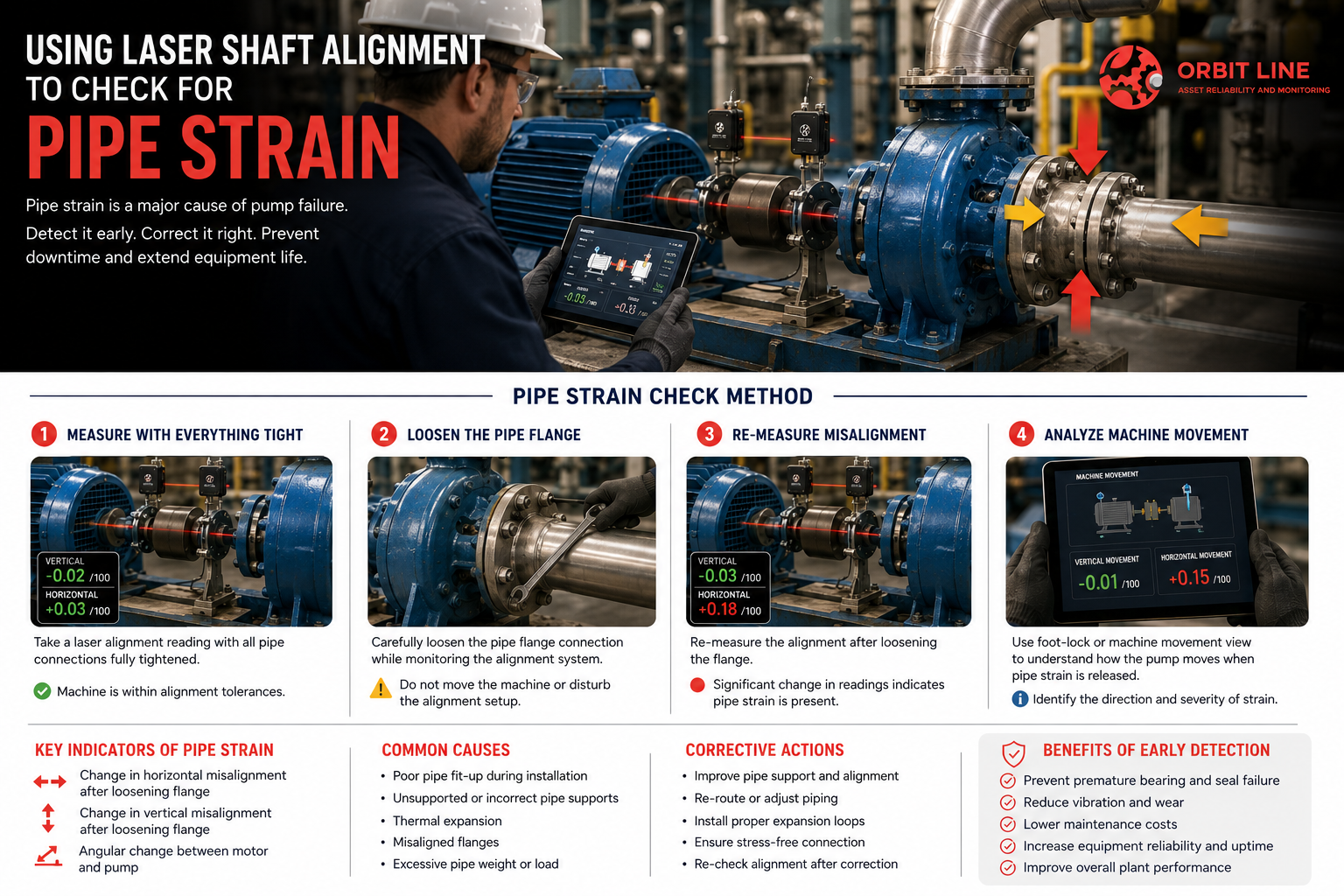
Pipe strain occurs when connected piping exerts excessive forces or moments on equipment nozzles. This condition is usually caused by:
- Poor piping fit-up during installation
- Unsupported pipe sections
- Thermal expansion effects
- Incorrect pipe routing
- Excessive pipe weight
- Misaligned flanges
When piping pulls or pushes on the pump casing, the machine can deform slightly, causing shaft misalignment and increased stress on internal components.
Common Effects of Pipe Strain
Uncorrected pipe strain may result in:
- Premature bearing failures
- Mechanical seal leakage
- Increased vibration levels
- Coupling wear
- Shaft misalignment
- Reduced equipment reliability
- Increased maintenance costs
Many pumps that repeatedly fail seals or bearings are ultimately found to suffer from excessive pipe strain.
How to Check Pipe Strain Using a Laser Alignment System
Step 1: Measure Initial Alignment
Perform a standard laser shaft alignment with all pump and piping connections fully tightened.
Record the horizontal and vertical alignment values.
Step 2: Loosen the Pipe Flange
Carefully loosen the pipe flange connection while monitoring the alignment system.
Observe any changes in:
- Horizontal offset
- Vertical offset
- Angular alignment
Step 3: Compare Results
If alignment values change significantly after loosening the flange, pipe strain is present.
Typical indicators include:
- Horizontal movement caused by lateral pipe loading
- Vertical movement due to unsupported piping weight
- Angular changes resulting from nozzle distortion
Step 4: Evaluate Machine Movement
Advanced laser alignment systems can identify how much the pump itself moves when piping forces are released.
This information helps maintenance teams determine the severity and direction of the strain.
Acceptable Pipe Strain Limits
While exact limits vary by equipment manufacturer, any measurable movement that causes alignment values to exceed recommended tolerances should be investigated and corrected.
The goal is to ensure that piping connections can be assembled without forcing the equipment into position.
Correcting Pipe Strain
Effective solutions include:
- Installing proper pipe supports
- Re-routing piping systems
- Adjusting pipe hangers
- Correcting flange fit-up issues
- Reducing thermal stresses
- Ensuring stress-free piping installation
Pipe strain should always be corrected before final shaft alignment is performed.
Benefits of Early Detection
Detecting pipe strain during installation or maintenance provides significant benefits:
- Longer bearing life
- Improved seal reliability
- Reduced vibration levels
- Lower maintenance costs
- Increased equipment availability
- Improved energy efficiency
Conclusion
Laser shaft alignment systems are not only alignment tools—they are powerful diagnostic instruments capable of identifying hidden reliability problems such as pipe strain.
By incorporating pipe strain verification into every alignment job, maintenance teams can eliminate a major source of premature equipment failure and ensure long-term machine reliability.
At ORBITLINE, our reliability specialists utilize advanced laser alignment technology to identify pipe strain, optimize machinery alignment, and improve asset reliability across industrial facilities.